
If you're looking to create content that can reach your target audience and rank on the first page of search engines like Google, writing a blog post is an essential part of digital marketing.
Writing for SEO involves researching keywords, staying up-to-date with algorithm changes and creating high-quality content that aligns with user intent.
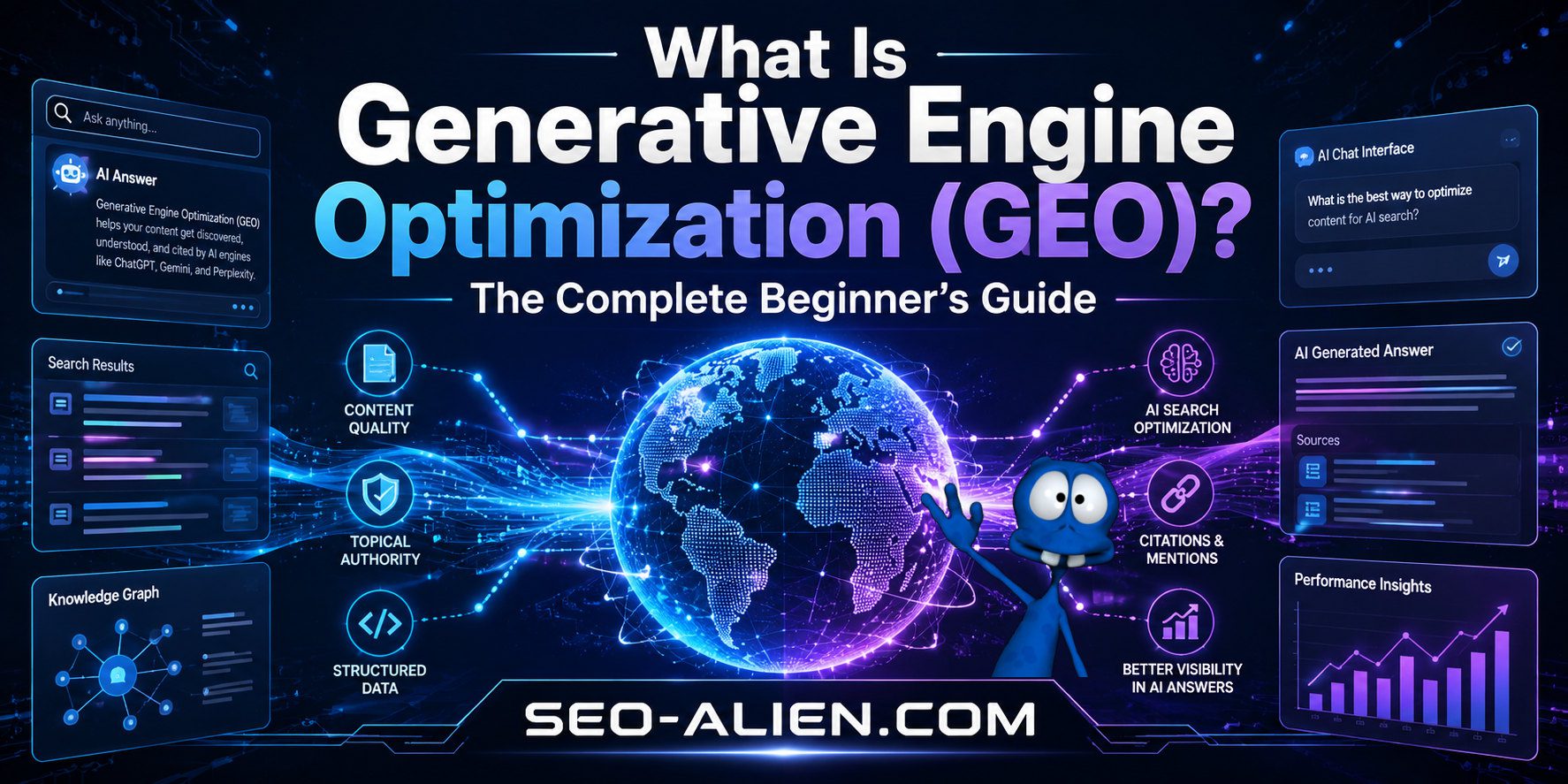
What Is Generative Engine Optimization (GEO)?
The Complete Beginner's Guide
If you've been paying attention to the future of search, you've probably heard the phrase Generative Engine Optimization (GEO) popping up everywhere.
Traditional SEO is no longer the only game in town. Millions of users are now asking questions directly to AI-powered search engines such as ChatGPT, Google AI Overviews, Gemini, Claude, and Perplexity instead of typing keywords into a search box.
That shift is creating a new challenge for website owners: How do you optimize your content so AI systems choose your website as a trusted source?
The answer is Generative Engine Optimization.
In this beginner's guide, you'll learn:
- What is GEO?
- How GEO SEO differs from traditional SEO
- Why AI search optimization matters
- How ChatGPT, Gemini, and Perplexity find information
- The best GEO strategies for 2026 and beyond
What Is Generative Engine Optimization (GEO)?
Generative Engine Optimization (GEO) is the process of optimizing websites and content so they are more likely to be cited, referenced, or used by AI-powered search engines and generative AI systems.
Instead of trying to rank #1 on Google alone, GEO focuses on becoming a trusted source of information for AI systems that generate answers.
Examples include:
- ChatGPT
- Google AI Overviews
- Gemini
- Perplexity AI
- Claude AI
- Microsoft Copilot
When these AI tools answer questions, they often rely on trusted websites with well-structured, authoritative, and highly relevant content.
GEO helps position your website to become one of those trusted sources.
Why GEO SEO Matters More Than Ever
Search behavior is changing rapidly.
Instead of searching:
"Best SEO strategies 2026"
Users are asking:
"What are the best SEO strategies for small businesses in 2026?"
AI search engines generate an answer instantly, often citing only a handful of websites.
If your content isn't optimized for these AI systems, your site may lose visibility—even if you rank well in traditional search.
The goal of GEO SEO is simple:
Become the source AI engines trust enough to quote.
GEO vs SEO: What's the Difference?
| Traditional SEO | Generative Engine Optimization |
|---|---|
| Optimize for Google rankings | Optimize for AI-generated answers |
| Target keywords | Target questions and intent |
| Focus on backlinks | Focus on authority and citations |
| Rank webpages | Become a trusted information source |
| CTR is important | Mentions and citations matter |
The future isn't GEO replacing SEO.
It's GEO plus SEO.
The websites winning in 2026 are doing both exceptionally well.
How AI Search Engines Find Information
AI search engines use a combination of:
- Traditional search indexes
- Knowledge graphs
- Trusted publisher websites
- Real-time web crawling
- Structured data
- User behavior signals
For example:
- ChatGPT may retrieve current information from the web.
- Perplexity AI cites multiple websites directly in its answers.
- Google Gemini relies heavily on Google's existing search infrastructure.
- Structured data helps AI systems better understand your content.
The better your content is organized and the more authoritative your website becomes, the more likely AI systems are to trust and reference it.
7 GEO SEO Strategies That Actually Work
1. Create Comprehensive Content
AI systems prefer pages that answer a topic completely.
Instead of writing a 500-word article targeting one keyword, create in-depth resources that answer:
- What is it?
- Why does it matter?
- How does it work?
- Who benefits?
- What are the pros and cons?
- What are the latest trends?
Comprehensive content increases your chances of being cited by AI.
2. Focus on Topic Clusters
AI doesn't think in keywords. It thinks in relationships between topics.
Create content clusters around major themes such as:
- Generative Engine Optimization
- AI Search Optimization
- Google AI Overviews
- ChatGPT SEO
- Topical Authority
- AI Content Strategy
Interlink these articles to build topical authority.
Learn more here:
WordPress SEO Strategy 2026: How to Rank Higher on Google with AI Optimized Content
3. Optimize for Questions
Most AI searches are conversational.
Write content that answers questions directly:
- What is GEO?
- How does GEO work?
- Is GEO replacing SEO?
- What is AI search optimization?
- Can ChatGPT recommend my website?
Question-based headings help AI extract answers quickly.
4. Use Structured Data
Schema markup helps AI understand:
- Articles
- Authors
- FAQs
- Reviews
- Organizations
- Products
Google provides an excellent guide:
Introduction to Structured Data
5. Demonstrate Real Experience
AI systems increasingly value:
- Expert opinions
- Case studies
- Real-world examples
- Original research
- Personal experiences
The more authentic and unique your content is, the harder it is for AI to ignore.
6. Build Brand Mentions Across the Web
AI engines pay attention to:
- Industry publications
- YouTube videos
- Podcasts
- Social media discussions
- Reddit conversations
- Guest articles
The more your brand is mentioned, the more authority your site develops.
7. Become the Primary Source
Want AI to quote your website? Publish information others don't have.
- Industry studies
- Original surveys
- Case studies
- Expert interviews
- Statistical research
- Data visualizations
Originality is one of the most powerful GEO ranking factors.
Will GEO Replace Traditional SEO?
No.
Traditional SEO is still incredibly important.
Google Search drives billions of visits every day, and ranking organically remains one of the most effective marketing strategies available.
However, AI-powered search is creating a second channel for visibility.
Businesses that embrace both SEO and GEO will have a significant advantage over competitors that rely solely on traditional rankings.
The Future of AI Search Optimization
The future of search is evolving from:
Ranking pages → Becoming trusted sources.
Generative Engine Optimization is not a passing trend.
It represents a fundamental shift in how people discover information online.
The websites that focus on expertise, topical authority, structured content, and genuine value will thrive in both traditional search engines and AI-powered experiences.
The sooner you begin optimizing for GEO SEO, the more prepared your website will be for the future of search.
Ready to Future-Proof Your SEO Strategy?
At SEO-Alien, we help businesses stay ahead of the latest trends in AI search optimization, Google AI Overviews, and next-generation SEO strategies.
Explore more resources:
 About the Author:
The SEO-Alien is a project started in 2009 regarding all things online marketing. The site started out more of a diary of predictions, suggestions and references to things I frequently used for online marketing... before social media marketing was even an option.
I hope you find the information and tools presented here useful and something worth sharing with others.
If there is anything else about online marketing or any online advertising strategy you think would be helpful, please let me know.

.png)