
This guide breaks down Google’s AI-driven ranking process and shows you exactly how to optimize your content for modern search.
How Google’s AI Ranks Content (Quick Answer)
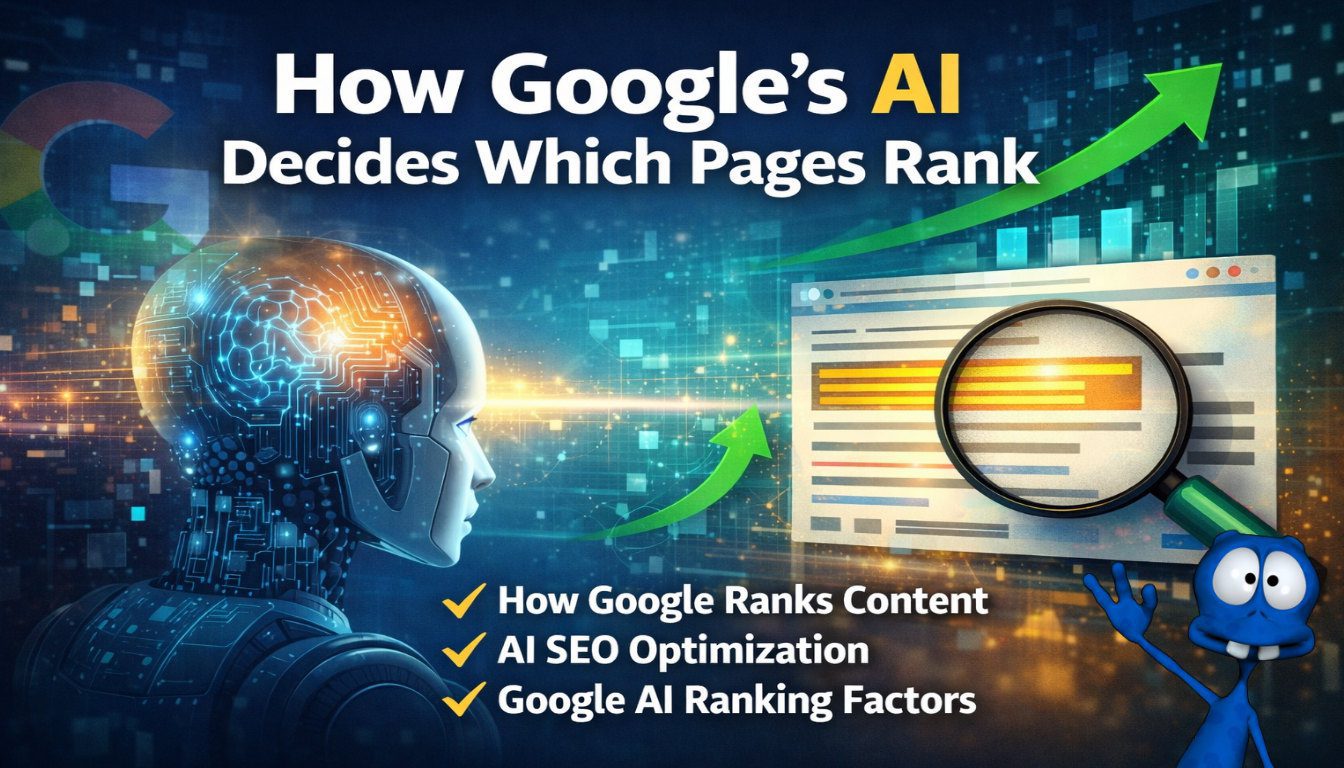
Google’s AI ranks content by analyzing relevance, content quality, user intent, engagement signals, and topical authority. Pages that best satisfy search intent while demonstrating expertise and trust are rewarded with higher rankings.
This answer-friendly structure is intentional — it’s optimized for featured snippets.
1. Google AI Ranking Factors You Must Understand
Google uses multiple AI systems — including RankBrain and the Helpful Content system — to evaluate pages. These systems focus on meaning, not manipulation.
Core Google AI Ranking Factors
- Search intent matching (informational, transactional, navigational)
- Content depth and clarity
- User engagement signals (time on page, interaction)
- Topical authority across related content
- Internal and external link context
For foundational concepts, review SEO basics to see how these principles work together.
2. How AI Understands Search Intent
Search intent is the backbone of AI-driven rankings. Google’s AI evaluates whether your page solves the problem behind the query — not just whether it contains keywords.
Types of Search Intent Google Identifies
- Informational: “How does Google rank websites?”
- Commercial: “Best SEO tools for AI optimization”
- Transactional: “Hire SEO consultant”
If your content doesn’t align with intent, it won’t rank — even with strong backlinks.
Learn how to optimize intent-driven pages with on-page SEO strategies.
3. What Is AI SEO Optimization?
AI SEO optimization is the process of structuring content so search engines can easily interpret relevance, quality, and usefulness using machine learning.
AI-Friendly Optimization Checklist
- Clear headings and subheadings
- Concise definitions early in the content
- Logical internal linking between related topics
- Natural language, not keyword stuffing
- Updated and accurate information
This is where many outdated SEO tactics fail. Artificial signals no longer outperform authentic value.
See ethical optimization in action with white hat SEO techniques.
4. Why Topical Authority Matters More Than Ever
Google’s AI evaluates entire websites — not just individual pages. Sites that cover topics comprehensively are seen as more trustworthy.
How to Build Topical Authority
- Create multiple articles around one core topic
- Interlink them naturally using descriptive anchor text
- Update older posts to maintain relevance
This internal linking structure helps AI understand content relationships and boosts crawl efficiency.
5. How to Optimize for Featured Snippets
Featured snippets are often selected from pages that clearly answer questions.
Snippet Optimization Tips
- Answer questions in the first 1–2 paragraphs
- Use bullet lists and numbered steps
- Write concise definitions under headers
This article intentionally follows those rules.
Frequently Asked Questions
Does Google AI penalize AI-generated content?
No. Google evaluates content quality, not how it’s created. Poor content is penalized — not AI itself.
How long does it take AI-optimized content to rank?
Typically 2–8 weeks, depending on competition, authority, and crawl frequency.
Is keyword optimization still important?
Yes — but only when combined with intent, structure, and value.
Final Thoughts: Ranking in the Age of AI
Google’s AI doesn’t reward shortcuts. It rewards clarity, authority, and usefulness.
If you focus on helping users first, structure content intelligently, and build topical authority through internal linking, Google’s AI will do the rest.
Modern SEO isn’t about beating the algorithm — it’s about aligning with it.

About the Author:
The SEO-Alien is a project started in 2009 regarding all things online marketing. The site started out more of a diary of predictions, suggestions and references to things I frequently used for online marketing... before social media marketing was even an option.
I hope you find the information and tools presented here useful and something worth sharing with others.
If there is anything else about online marketing or any online advertising strategy you think would be helpful, please let me know.

.png)